
What’s on the other side?
“A door is what a dog is perpetually on the wrong side of.”
Previously at the Volcano Base I’d been making software that does the explaining. Since then it’s been a busy week, automating systems and creating databases you can talk to.
Mission Briefing: The Threshold
Work used to have a shape
For most of modern business history, work arrived pre-sorted. The goal came from the top, got divided into tasks, and each task found its way to a specialist clutching a specific set of tools. The marketing manager had her software. The analyst had his spreadsheets. The project manager had whatever project managers have - something beige and Gantty.
This wasn’t just organisational convenience. It was a mental model so deeply embedded that nobody thought to question it, in the same way that nobody questions why offices have corridors. Work is what people do with tools. The org chart is the map of who does what with which tools. The workspace is where that happens. Obviously. Next question.
That mental model is now substantially wrong.
One threshold, everything else
Look at what’s actually being built. Paperclip lets you describe a company goal and conjures a hierarchy of AI agents to pursue it - CEO, CTO, engineers, marketers, each with a budget and a job description. Microsoft’s Copilot Cowork lets you describe an outcome and watches it coordinate across your calendar, email, files and data without further instruction. Perplexity’s Personal Computer runs on a dedicated Mac mini, 24/7, connected to 20 frontier models, essentially waiting in the dark for you to want something. A developer in Germany rebuilt the whole thing in n8n for the cost of a VPS and a free afternoon.
Different products. Wildly different price points. Same underlying shift.
Previously: work is what people do with tools. Next: work is what happens when you describe an outcome.
The control surface has become the threshold - the point where your intention ends and everything else begins.
Why established businesses are going to find this extremely difficult and probably won’t admit it
The businesses with the most to gain from this shift are, with pleasing predictability, the ones least able to make it.
Management consulting firms sell the org chart. SaaS companies sell the specialist tools. Enterprises like Microsoft are at least attempting something - but notice what Copilot Cowork actually does. It doesn’t replace the hierarchy. It gives the hierarchy a very capable intern. Your meetings still exist. Your approval chains still exist. Your nineteen-tab browser situation still exists. Copilot is now embedded inside a structure that may no longer need to be quite so elaborately structured, gamely making it run faster.
This isn’t really a technology problem. It’s an incentives problem dressed up as one. You can’t sell “you probably don’t need most of this” to customers who’ve spent twenty years building most of this and whose entire revenue model depends on everyone continuing to need it.
Microsoft, to be fair, is also running Claude under the hood and paying Anthropic handsomely for the privilege, which is at least honest in its way.
The advantage of having nothing to unlearn
If you run a small operation - a consultancy, a solo practice, a lean team - you are holding an advantage that the breathless AI coverage tends to skip past.
The advantage isn’t speed. It’s that you have nothing to unlearn.
You never had a team of specialists to protect or a workflow that seventeen people depend on staying exactly as it is. You’re already accustomed to describing what you want and figuring out the rest yourself. The AI workspace isn’t asking you to reorganise your business. It’s offering to stand on the other side of the threshold and catch whatever you throw.
A company of one with a good control surface can now operate at a scale that would have required a small agency five years ago. Not because the AI is magic - it is notably not magic - but because the bottleneck was never ideas or strategy. It was coordination, execution, and the sheer number of specialist hands needed to get from intent to output.
That bottleneck is now optional equipment.
The borrowed metaphor
Everyone building these workspaces has reached for the same image: the company. Org charts. Job titles. Reporting lines. Budgets per agent. Even the most radical ones - Paperclip’s “zero-human company” crowd - have faithfully recreated the corporation in miniature, just with agents where the people used to be.
Which works, practically. But it does make you wonder whether we’re automating work, or automating our idea of what work looks like. The org chart was always a simplification - a way of making the chaos of human effort legible to the people paying for it. We’ve now made that simplification run considerably faster, which is useful, without necessarily asking whether the simplification was serving us particularly well to begin with.
The most interesting question right now isn’t which workspace wins the market. It’s who’s willing to actually change how they think about work - rather than just change the tools they use to do it exactly the same way as before, only quicker.
Classified Intel
Some interesting stuff I discovered on my adventures.
Paperclip - The Zero-Human Company, Now in Open Source
An open-source framework for running an entire business with AI agents - complete with org charts, budgets, heartbeats and governance. Think of it less as a tool and more as an operating system for a company that doesn’t need you in it. Worth a look if you want to understand where the autonomous end of this market is heading, or if you fancy running a faceless TikTok factory as a side project. Please don’t do the latter.
paperclip.ing
n8n-claw - OpenClaw, But You Own It
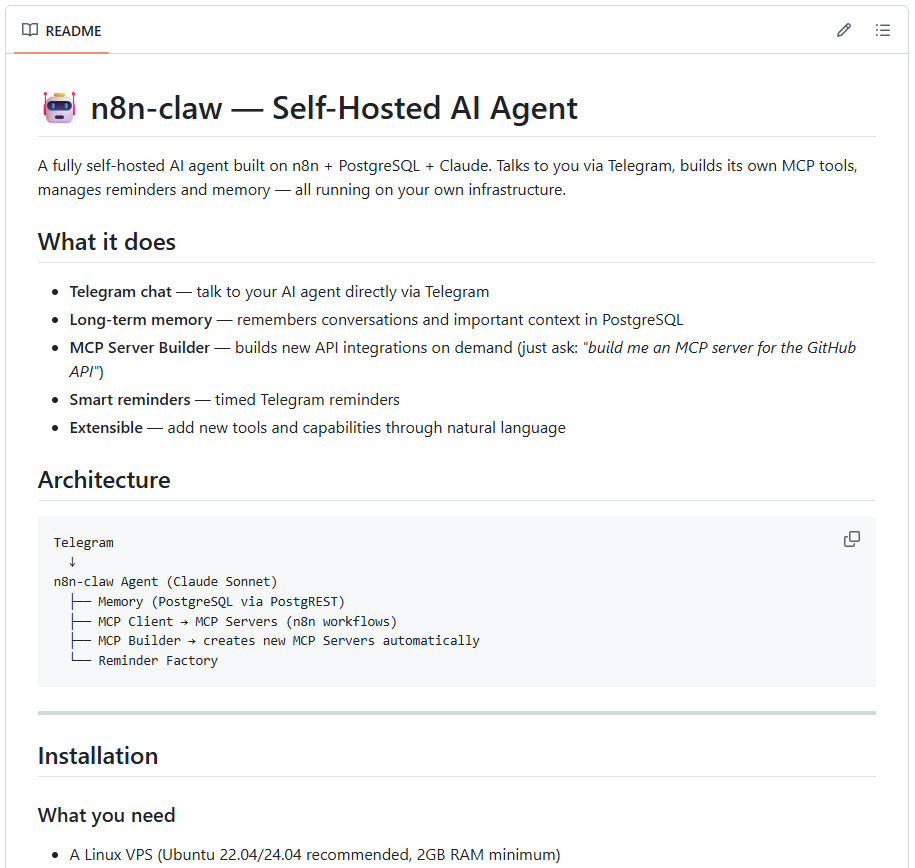
A community developer has rebuilt the OpenClaw autonomous agent inside n8n, the self-hostable workflow tool, backed by Supabase and controlled via Telegram. Scrappy, extensible, and deliberately built so non-programmers can follow what’s happening. The grassroots end of the AI workspace spectrum - and arguably the most honest version of it.
Perplexity Personal Computer - AI Is the Computer
Perplexity wants to put a dedicated Mac mini on your desk running 20 frontier models, 24/7, connected to your local apps and the internet. The pitch: your Mac mini becomes a digital proxy that works while you sleep. Perplexity claims to have done 3.25 years of work in four weeks using it internally, which is either extraordinary or a very creative way of counting.
Stop working so hard. Volcano Base helps you automate the mundane, outsmart the grind, and build real momentum. No tech skills needed.
Volcano Base is sponsored by…
Cogitation+
Introducing the world’s first organic, non-agentic, zero-latency thought process - now available without a waitlist.

Integrates with walking, staring and lying down
Cogitation+ is a revolutionary new approach to knowledge work that requires no API key, no Mac mini, and no monthly subscription. Simply locate a comfortable surface, reduce external stimulation, and allow your biological neural network to process information without instruction.
Early users report unexpected connections between ideas, spontaneous problem reframing, and the occasional solution to something they weren’t even thinking about.
Cogitation+ integrates natively with walking, staring out of windows, and lying on the floor.
Cogitation+. The original control surface. Used by Aristotle, Newton, and that dude who had a revelation in the bath.
