

Waaaaaaaaa!
“The art of being wise is the art of knowing what to overlook.”
Previously at the Volcano Base I’d been observing that the nature of work is changing. Since then, python has featured very heavily in a massive data transformation project I’m working on. Creating a “single source of truth” across all of a company’s systems.
Incidentally, I’ve got nothing lined up after this one finishes. Eeeek. Tell your friends (or enemies).
Mission Briefing: The Square Peg Paradox
Hiring for fit
Every job description is a small organisational autobiography. It tells you not what the company needs, but what it's comfortable with. And what companies have been comfortable with for the better part of a century, is certainty.
Specifically: they want someone who has done this exact thing, in this exact context, a documentable number of times. A square peg. For a square hole. Produced to spec, installed without drama, guaranteed not to ask uncomfortable questions about the shape of the hole.
This is entirely rational, given that the hole was square yesterday, was square the day before that, and there has been precisely no indication from anyone in personnel that the geometry was under review.
The problem is that someone has just shown up with a completely different drill.
The thing they're filtering out
There's a quality that doesn’t appear on CVs, because it doesn't look like a qualification. It looks, from the outside, a bit like recklessness. From the inside, it feels more like a different relationship with not knowing things.
It’s three things operating in combination. First: being genuinely comfortable saying "I don't know" - which is one of the more reliable markers of actual intelligence, despite being treated in most interview rooms as a career-limiting confession. Second: the curiosity to go and find out anyway, immediately, using whatever's available. Third: the willingness to throw yourself at the problem before you have any formal business doing so and to treat the learning that results as the actual point.
Most organisations have spent considerable effort building systems that screen this out. They've done it very thoroughly. You almost have to admire the consistency.
Why this hasn't mattered until recently
For most of corporate history, "has done this before" was a perfectly serviceable proxy for "can do this." Learning on the job was slow and expensive, and usually required the organisation to carry someone patiently while they accumulated enough accidental competence to be useful. Hiring proven people was the rational hedge against uncertainty.
That calculus has shifted rather dramatically.
Learning by doing has never cost less. Not in time, not in effort, not in access to the sort of expertise that used to live exclusively inside expensive people with impressive titles. The distance between "I have no idea how to do this" and "I have now done this and could probably explain it to someone else" has collapsed to something that looks, from the perspective of 2019, implausible.
You can build a working prototype of something you'd never touched before last Tuesday. You can get reasonably competent at something in an afternoon that previously required a course, a mentor, an expensive mistake, or ideally all three. The raw material of getting good at things - information, tools, feedback, iteration - is now available in quantities that would have seemed excessive even to people who considered themselves well-resourced.
The organisations best positioned to take advantage of this are the ones staffed by people who were already, for entirely unrelated reasons, wired exactly that way.
What the incumbents can't do
Large companies don't merely prefer the square-peg model. They are architecturally committed to it. Their job descriptions, their performance frameworks, their org charts, their recruitment pipelines, their entire epistemology of what a competent employee looks like - all of it is scaffolding erected around the assumption that roles are stable, expertise is transferable between predictable contexts, and the hole will remain square.
You can’t simply send an email saying "from now on, everyone should be comfortable not knowing things." The system has opinions about this, and they are structural. The person who says "I don't know how to do this yet" is still, in most large organisations, the person whose performance review goes in an unfortunate direction.
The incentives run the other way too. The management consultancies sell the org chart. The SaaS companies sell the specialist tools. The whole ecosystem of enterprise technology has been lovingly constructed around the premise that specialists need specialist software to do specialist things in their specialist lanes, and this arrangement should continue indefinitely because it’s extremely good for revenue.
It’s not clear how you productise "you probably don't need most of this."
The unearned advantage
Which leaves the people who've been operating without an org chart - the consultants, the solo practitioners, the small teams that have always had to figure things out in real time because no one was going to do it for them.
They didn't build a strategy around being adaptable. They were just adaptable, because the alternative was not eating. They said "I don't know" in the morning and "here's what I found out" by the afternoon, not because they were visionary but because that was how things got done.
The companies of the next decade will be built by people who were never waiting to be qualified. This was, until recently, a mild inconvenience. It’s becoming, at a speed that is frankly a bit rude, a structural advantage.
The hole has changed shape. The square peg registry is already full.
What have you attempted this week that you technically weren't qualified to attempt yet?
Classified Intel
Some interesting stuff I discovered on my adventures.
Anthropic's Use Case Library - AI Beyond the Chat Box
Anthropic has published a growing library of practical examples showing what Claude can actually do across real work contexts - from reconciling transactions to prepping compliance audits to building daily briefings from across your tools. Most people's experience of AI is still essentially a chat box with a good memory. This is a useful corrective - a browse through here tends to shift the question from "is AI useful?" to "what specifically should I use it for?"
Dispatch - The Control Surface Gets Mobile
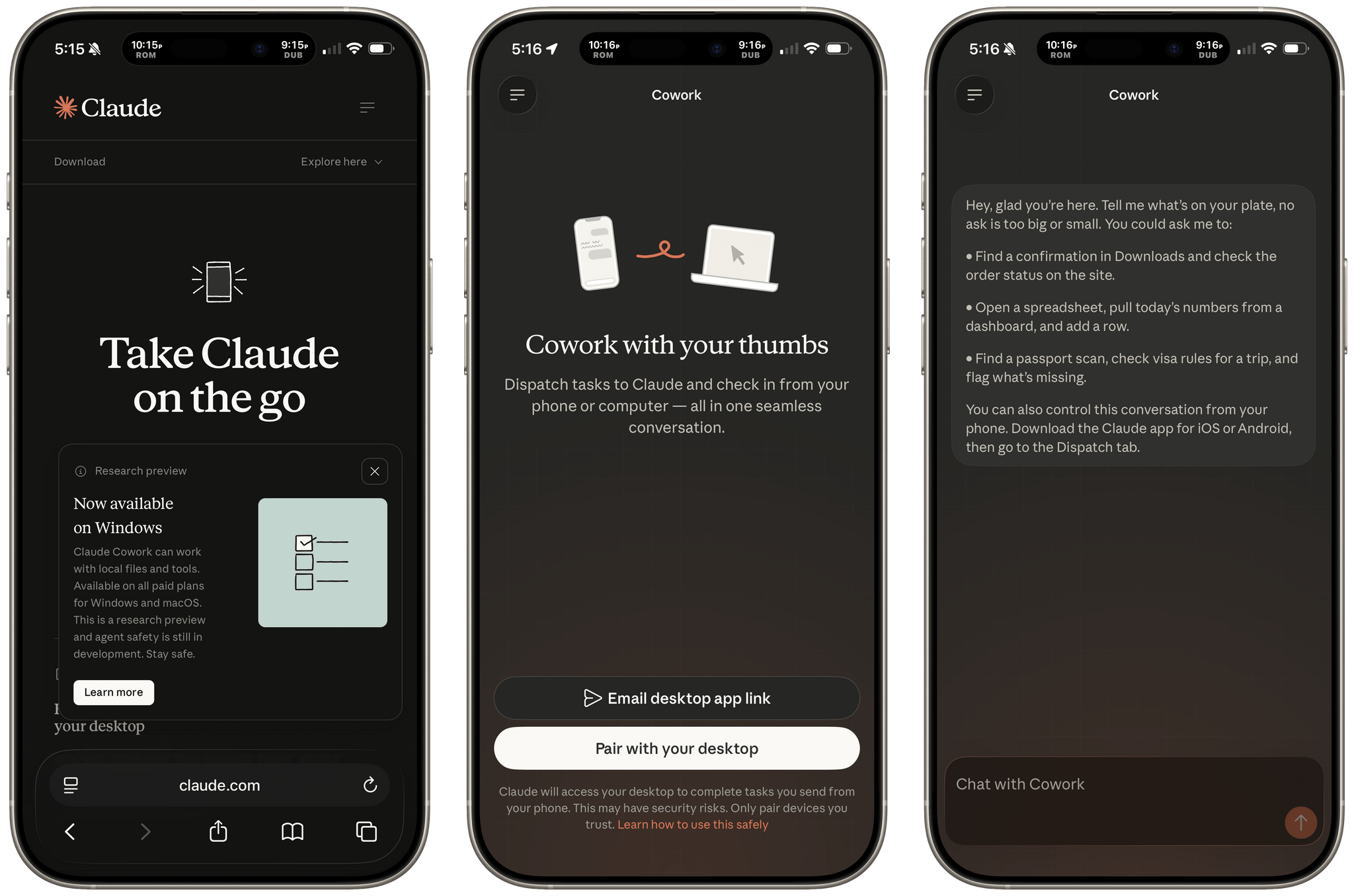
Anthropic has launched Dispatch, a research preview that lets you drive a Mac-based Cowork session from your iPhone. Point your phone at a QR code and you have a remote control surface for your desktop - describe what you want from the sofa, the train, or wherever you happen to be when the thought strikes. As covered in the last issue, the interesting shift isn't the product itself but what it represents: the control surface keeps getting thinner, more ambient, and more willing to follow you around. It's currently about a 50/50 success rate - rough around the edges, as research previews reliably are - but the direction of travel is clear. The threshold keeps moving closer to wherever you happen to be.
AI Make or Buy in 2026 - It's Not Which Tool You Choose
Tobias Zwingmann revisits his 2023 make-or-buy framework and finds the landscape has changed considerably. The useful reframe for anyone who gets asked "should we use Claude, ChatGPT, Gemini or Perplexity": that is not quite the right question. The real moat isn't the platform you chose but what you chose to do with it - specifically, whether you've got the data, the process clarity, and the organisational readiness to actually use it. The technology is increasingly commoditised. The wrapper you build around it, and the organisation that knows what to do with it, isn't.
Stop working so hard. Volcano Base helps you automate the mundane, outsmart the grind, and build real momentum. No tech skills needed.
Volcano Base is sponsored by…
The Square Peg Registry

Predictable
The world's only professional body dedicated to the preservation of proven, contextually-verified, previously-demonstrated expertise. Established sometime after the concept of job descriptions and before anyone thought to question them.
At the Square Peg Registry, we believe the single most dangerous thing a person can do in a professional context is attempt something they haven't already done. That's why we maintain the world's most comprehensive database of people who have done exactly this thing, in exactly this context, a number of times sufficient to appear on a CV without anyone raising an eyebrow.
Our members are pre-matched to roles (square holes) using a proprietary algorithm that cross-references sector experience, job title history, and a short questionnaire designed to identify and gently redirect anyone who has ever said "I figured it out as I went along" as if that were something to be proud of.
New contexts are not supported. Adjacent industries require a 12-month recertification programme. Curiosity is flagged for review by a sub-committee that has been reviewing flagged curiosity since 2009 and has yet to conclude.
The Square Peg Registry. If it worked before, it'll work again. Probably. Terms apply. The terms were written by someone who had written terms before.
